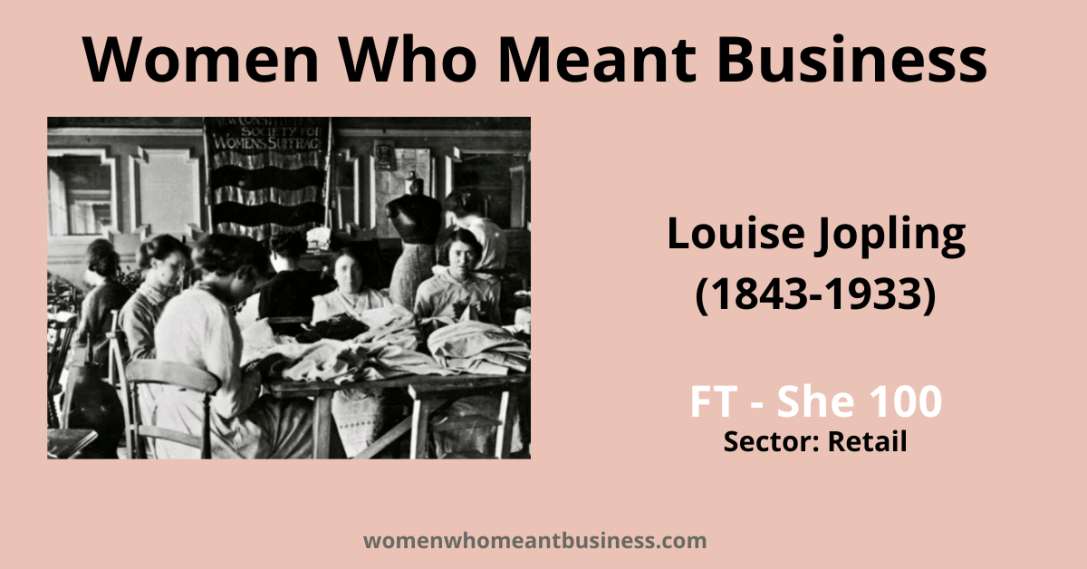
Born: Louise Jane Goode; Also known as Mrs Romer; Mrs Jopling Rowe
Sector: Retail (Specialised Consumer Services)
The artist Louise Jopling had a long career, spanning five decades from the late 1860s to the early 1900s. Born the daughter of a railway contractor, she began her training in her early 20s, when she was living in Paris with her first husband. She went on to exhibit her work at the Royal Academy and the Grosvenor Gallery, alongside still-renowned painters including James McNeill Whistler and the pre-Raphaelite Boys Club. But don’t feel bad if you have never heard of her. Only a handful of British museums and galleries hold her work. The Tate made an acquisition only in May 2024. Despite the fact that she specialised in portraits, the National Portrait Gallery has just one of her sketches. Because she was painted by two celebrated male artists, Whistler and John Everett Millais, you are more likely to have seen a portrait of her than one by her.
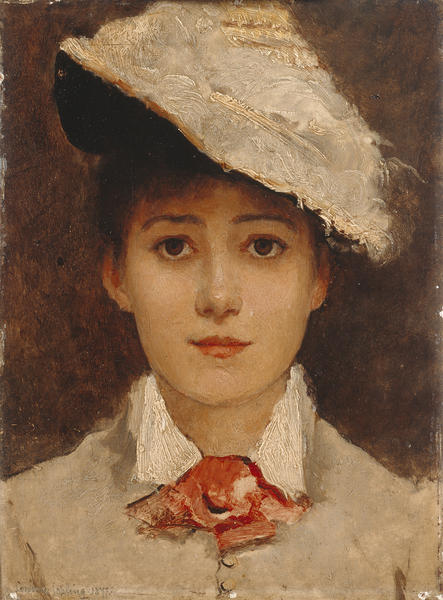
Manchester Art Gallery
By developing a successful career in a male-dominated profession, Louise Jopling has already earned her place in the history of art. She is part of the FT-She 100 because for around thirty years she also ran a successful commercial enterprise, ‘Mrs Jopling’s School of Art’. Her business was born in 1885, a result of personal tragedy and financial necessity.
Louise’s second husband, Joseph Middleton Jopling, who was also a painter, died suddenly in December 1884, leaving Louise aged 41 with a son, Lindsay, to support, the only one of her four children still living. In the portrait market, which was where artists made their money, being painted by a highly-regarded artist elevated the status of the sitter and artists who forged relationships with wealthy patrons were unlikely to find themselves starving in a garret. Louise had a good relationship with Lindsay Coutts, founder of the Grosvenor Gallery, and was championed by the Rothschild family but her male contemporaries tended to get the best wall space at the Royal Academy and she was not able to command the same sorts of prices for her work as her male counterparts, or attract as many wealthy patrons. She needed to find a way to supplement her income.
In late 1885, Louise started to give ‘demonstration’ classes in her studio. This form of tuition involved painting a life-size head over several hours, demonstrating a range of techniques to students in the process. These went well and by November 1886, she was advertising her classes. They included life classes, something she deemed critical for an artist’s development but still not as easy for women to access as men.
In 1886, Louise sold the house she had shared with her husband to move somewhere smaller in South Kensington but she made sure that her new home had a studio large enough for her to continue teaching. As interest grew in ‘Mrs Jopling’s School of Art’, the venture became more formal. She developed a more complete curriculum, including tuition in watercolours, black and white illustration and sculpture. She took an extra studio in nearby Clareville Grove and recruited other teachers to tutor up to thirty students. At first her sister helped her with the day-to-day running but in 1888 a formally-appointed director took over. Louise was one of the first people to be interviewed by Henrietta Müller when she launched her Women’s Penny Paper that same year. Müller devoted a good chunk of the article to the art school, commenting: ‘Mrs Jopling-Rowe, apart from her own artistic career, is doing excellent work at her school in teaching women-students to work in earnest.’
Louise’s decision to start this commercial enterprise coincided with her playing a more active part in the suffrage movement. Her first marriage, to Frank Romer, had ended in a separation in 1871 after 11 years, mainly as a result of his gambling habit. This was when she started to see how disadvantaged married women were by the legal system.. One of the female figures she painted that year was Vashti, a queen of Persia ‘who always had a great attraction for me, as the originator and victim of “Women’s Rights.”’ She signed a letter supporting women’s suffrage as early as 1884 and was clearly very well aware of the challenges facing women wanting to be professional artists.
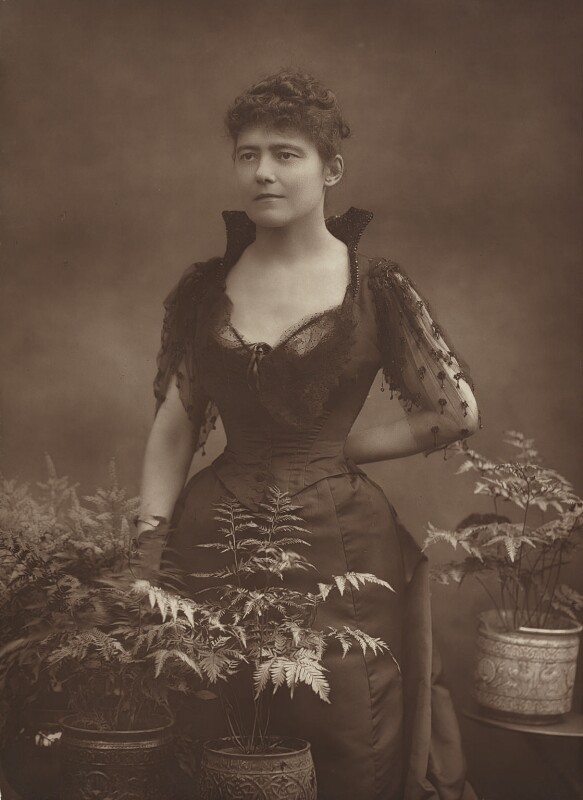
carbon print, 1890 or before. NPG Ax8712
© National Portrait Gallery, London
The Art School gave journalists a new angle on Louise and her new position helped her connect with other women who were keen to broaden out women’s opportunities in education and work. In 1891 Louise was one of the four women who were founder members of the Royal Society of Portrait Painters but she loudly protested about the fact that women were not given the same voting rights as the men. After further discussion, Louise’s argument for equal rights was accepted. ‘I believe this was the first time, at public meetings, that women were treated on an equality with men, at any rate in artistic circles; and, since then, there has never been any question of their not being so regarded’, she later wrote. By 1893, Louise was a member of the Pioneer Club and painted a portrait of its co-founder, Emily Massingberd.
In 1894, Louise moved again, to 3 Pembroke Road in South Kensington, and re-located the school to a larger building backing onto it in Logan Place. In 1901, she set up a new business, the Jopling Art Club. For a fee of 5 guineas a year artists who had exhibited in any London gallery could work from the school model every morning, use the studio for private work in the afternoons and evenings and exhibit their work at the weekends. Amateurs were also allowed to join, thought they had to pay 10 guineas a year. Louise used the school to host political meetings and lent it or hired it out to others with a feminist agenda: in November 1903, the Irish novelist and educator Elsa d’Esterre-Keeling (1857-1935) ran debating classes for women there. ‘Many of those present were professional women who said they deemed the power of the “ready answer” as one to be reckoned with in advancing a career.”
Louise started to write and lecture on art as a profession for women. Common themes were the importance of equal access to education and giving women the opportunity to live independent lives. In 1891, she wrote a book for art students, ‘Hints To Amateurs’, which ran to four editions. In 1903, she contributed an essay to a book in the same Woman’s Library series as the photographer Alice Hughes. Interviewed in the Windsor magazine in September 1906, Louise was clear that in the world of art, the playing field was still not even: ‘With men, the port of success is gained with a fair wind and every favour; with women, harbour is reached only by those who are willing to weather every sort of storm.’ By now she was also voicing her support for the WSPU and, having moved to Pembroke Gardens near Kensington High Street, became active in the Kensington branch. In 1908 she hosted a series of ‘At Homes’, painted a banner for the artists’ section of the huge June demonstration in Hyde Park and penned new words to an old Scottish folk tune, ‘There’s Nae Luck About the House’:
The Song of the Suffragette

Oh! Womenkind of England now,
Be worthy of your blood;
Let Courage shine upon your brow,
In spite of Men and Mud!

"For Britains never shall be slaves!"
Now, was this said in joke?
The Flag of Freedom only waves
O'er half the Island's folk!

Come, Men of England, show your pluck,
And free your Women too;
About a House there is no luck,
Unless it's ruled by two!
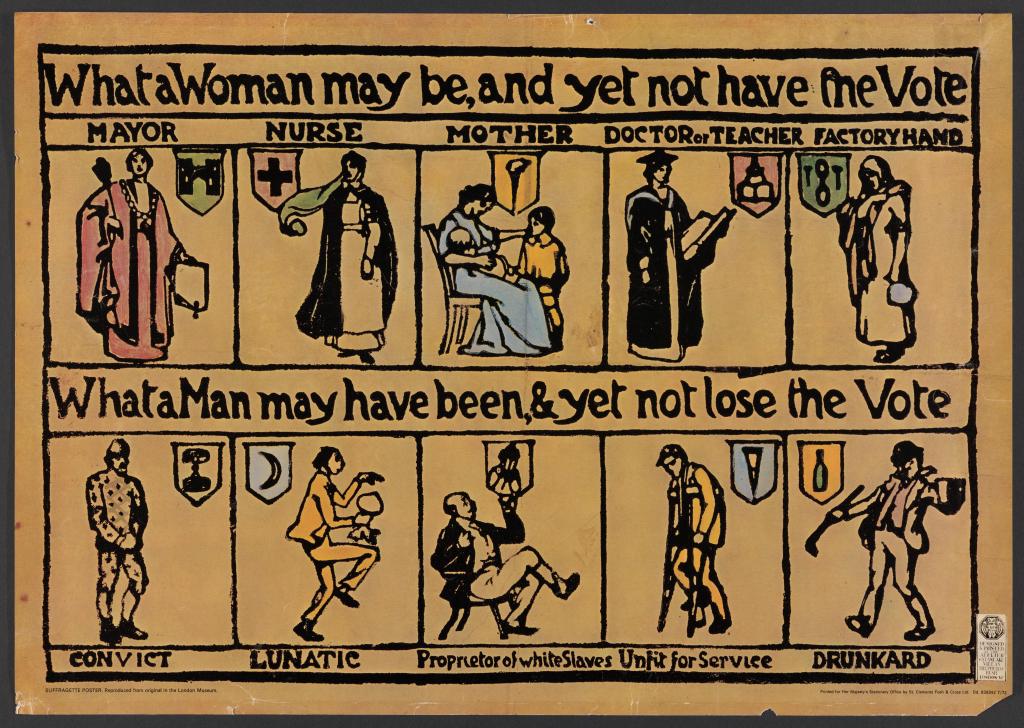
Louise must have also known Lena Ashwell: when the Actresses’ Franchise League were preparing for their part in the grand procession of 1911, Louise made a banner for the Musicians’ Section. She was a supporter of the Women’s Tax Resistance League and in February 1914 switched her allegiance to the United Suffragists, becoming one of their vice presidents along with Mrs D.A. Thomas, the mother of Margaret, Lady Rhondda. She was also sponsor of another commercial organisation, the Suffrage Atelier, founded by Clemence Housman and her brother, Laurence in 1909. Located a five-minute walk from Louise’s house in Pembroke Gardens, it was a co-operative which created propaganda for the women’s suffrage movement to use in poster campaigns and marches and sell at stalls.
It was only towards the end of the First World War that Louise made some changes in her life. Now in her seventies, she gave up her house in London, closed the school and moved to Amersham, her home until her death in November 1933.
Described as ‘artist and lecturer’, several of Louise’s obituaries focused more on her personal characteristics of energy and charm and the Millais portrait than her professional accomplishments. The school and her suffrage activity generally went unmentioned but their inclusion gives a fuller and truer picture of her career as well as highlighting the role she played in opening up art as a profession to women who came after her.
There is currently a research project into Louise Jopling’s life and work underway in Glasgow so perhaps slowly her work at the easel as well as her wider activism will receive more recognition. You can read more about her in this post from Amersham Museum and see more of her work here.
The National Gallery has made a short video about why only 21 of over 2,300 paintings in their collection are by women. Or you could read this seminal essay by Linda Nochlin from 1971, Why Have There Been No Great Women Artists?
Sources include:
Women’s Penny Paper 7/12/1888; The Queen 30/11/1901; London Daily News 30/11/1903; Leicester Daily Post 7/9/1906; Votes for Women 5/3/1908; 14/5/1908; 18/6/1908; 2/6/1911; 13/2/1914; The Field 11/9/1911
‘Twenty Years of My Life: 1867 – 1887’ by Louise Jopling (1925)
Louise Jopling: A biographical and cultural study of the modern woman artist in Victorian Britain by Patricia de Montfort (2017)
“An Art School of Their Own: Women’s Ateliers in England, 1880–1920” by Maria Quirk (2013) in Woman’s Art Journal, Vol. 34, No. 2 pp. 39-44; “Portraiture and Patronage: Women, Reputation and the Business of Selling Art, 1880–1914” by Maria Quick (2016) in Visual Culture in Britain Vol 17 Issue 2 P.181-199
 Women Who Meant Business