She equipped women to take advantage of the freedoms offered by the car
Born: The Honourable Gabrielle Margaret Ariana Borthwick
Sector: Automotive
Age-ism is the last taboo, one of the most common but least-discussed areas of work-place discrimination. A report in 2023 suggested there was no good age for working women. Discrimination can take the form of ‘youngism’, with early high-achievers facing a credibility deficit, but is far more often discussed in the context of ‘oldism’. Field research has found that women start to experience oldism ten years earlier than men, at around 40 rather than 50, as they begin to be overlooked for development and promotion.
This project features several women who were well into their 40s when they started the work for which they are now best known. They include Constance Spry and Syrie Maugham, both 42, Hilda Hewlett, 44, and Laura Annie Willson and Amy Dillwyn, both 47. The Honourable Gabrielle Borthwick was another women who found her calling relatively late, entering the world of commerce by setting up her own garage when she was in her late 40s.
Gabrielle’s life started along a fairly traditional path. Born on 30th June 1866, she was the first child of a Scottish laird, with a younger brother and three younger sisters. Her father, who was a stockbroker, fought hard to re-establish the dormant Barony of Borthwick. After he succeeded he bought a suitable home, Ravenstone Castle, close to Wigtown in Scotland, to go with the family’s house in Mayfair. Gabrielle was educated by governesses and presented at court in 1884.
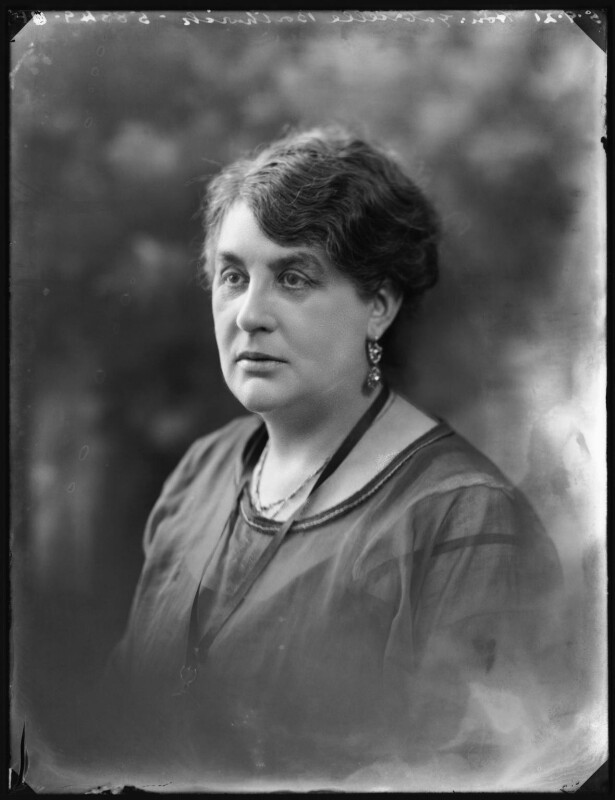
whole-plate glass negative, 5 September 1921
NPG x121152 (c) National Portrait Gallery
The first sign that she was veering off track was when she joined the Theosophical Society in 1885, where perhaps she would have met Henrietta Müller. In 1891 she was accepted into the Hermetic Order of the Golden Dawn, a secret society founded in 1888 that was devoted to the study of the occult and strongly influenced Western magical beliefs and practices. W.B. Yeats and Maud Gonne were two of its most famous members. Its structure was influenced by the Freemasons, with a number of different temples, but unlike the Freemasons it admitted women. Gabrielle joined the Iris-Urania Temple in London and completed the necessary studies to be initiated into the Second Order on 8th July 1897. It is not known how long she continued to be an active member.
Enjoying this story? Subscribe to my newsletter or follow me on instagram to find out more about pioneering business women and their networks, as well as relevant exhibitions, talks, books and events.
The road to freedom
In the early 1900s the advent of the automobile age opened up an exciting new world for wealthy and adventurous women like Hilda Hewlett. There is no record of Gabrielle participating in these early competitions but she must have been a relatively early adopter because she had been driving for a number of years before she started to develop an interest in mechanics. In 1913, she turned her hobby into a business, setting up a garage in Slough and then one in Northwood where women could learn to drive and how to maintain their cars. Given her family situation, Gabrielle probably found it easy to access the capital needed to take out leases on the sites and install the necessary equipment.
The outbreak of war in 1914 created all sorts of opportunities for women who could drive. Ethel Wilson was one of many who in August and September helped ferry nearly 250,000 Belgian refugees, flooding into the towns along Britain’s south coast, to temporary accommodation. In France, as the casualty count rapidly escalated, motorised ambulances were used for the first time and drivers were sorely needed. The First Aid Nursing Yeomanry, established in 1907, was quick to mobilise and women also signed up to drive for the British Red Cross and the Women’s Army Auxiliary Corps. However, even as women were driving ambulances and War Office lorries filled with troops and baggage, the Home Secretary, Reginald McKenna, creator of the infamous ‘Cat and Mouse Act’, still refused to grant them licences as taxi or bus drivers.
Nevertheless, there was plenty of business for Gabrielle, who moved her workshop to 8 Brick Street in central London. On 10th September 1915 an advert appeared in the suffrage newspaper Common Cause offering lessons in ‘Mechanism, Driving and Running Repairs.’ She branded herself as a ‘Motoring Expert’ and emphasised her feminist credentials: this was a ‘Ladies’ Automobile Workshop’ where Ladies were trained by Ladies.
Learning to drive didn’t come cheap: at a time when the average salary was £1 a week, 12 lessons cost three guineas (c.£3); for 30 shillings (c.£1.50), clients could attend an evening course of eight lectures and eight ‘mechanical demonstrations’. The lectures were held in Gabrielle’s drawing room, where artistic tapestries provided the backdrop for her show-and-tell on engine parts. She set up a motor field-kitchen and mounted an ambulance on a chassis so drivers wanting to head to France to support the war effort was fully-prepared. She also added second-hand car dealing to her list of services. Selling cars, Gabrielle thought, required immense tact, keen business sense and shrewd observation, skills women had in abundance. By the end of 1915 there was mention of a second garage in Essex. She was photographed with her pet Great Dane at around this time, probably in the street outside her garage.
During 1916 Gabrielle urged women to consider motoring as a profession. They could take jobs as private chauffeurs or perhaps combine chauffering with secretarial work; there was also demand for drivers of commercial vans. Women who were owner-drivers could save a lot of money on garage bills if they knew how to keep their car on the road and could make their own repairs. Innovations in car design already made it easier to change a tyre, with detachable rims and wheels. ‘A wheel can be changed in seven minutes’, she claimed. She was featured in national newspapers and magazines. When The Sphere ran a photo story in April 1916 on ‘War-time Professions and Industries for Women’, readers saw women at Gabrielle’s school learning mechanics and teaching men to drive. ‘Woman’s enterprise has seldom been more strikingly illustrated than in the case of the Hon. Gabrielle Borthwick, whose motor school..has proved a great success,’ wrote Gladys de Havilland in The Queen.
Post war activities
Gabrielle had shared the optimism of many that women would be rewarded for demonstrating their engineering capability during the war with more opportunities when it was over. At the very least, they would be able to retain the positions they had. The engineering unions thought differently and the Women’s Engineering Society was established to fight the proposed Restoration of Pre-War Practices Act, with Laura Annie Willson one of the founder members. Gabrielle joined in 1920. The organisation was based at 46 Dover Street, right next to the engineering training school and consulting business opened by Cleone Griff in 1914. Adverts for their two businesses often appeared on the same page in newspapers and in 1922 they both wrote for The Woman Engineer, Cleone on the recent Motor Show and Gabrielle on ‘The Work of a Garage’. In 1923, Gabrielle joined Lady Gertrude Crawford in becoming a director of Cleone’s new business, the Stainless and Non-Corrosive Metals Company and the following year the pair of them set up an estate agency.
In the early 1920s, Gabrielle significantly expanded her Piccadilly site, renamed it Borthwick House, and made it the base for other commercial ventures. London commuters could park their cars at ground level. She let out rooms on the upper floors of the building and in January 1923 started the Tudor Restaurant on the first floor. She also kept a separate flat, moving to 106 Ebury Street in Pimlico where her neighbour was the photographer Alice Hughes. Alice’s archive was lost in the Second World War so we will never know if Gabrielle visited her studio but given the circles Gabrielle moved in she would certainly have known who Alice was.
Her involvement in racing was the other thing that kept her name in the press. In 1927, the Women’s Automobile and Sports Association was formed. The first president was Irene Mountbatten, Marchioness of Carisbrooke, and Gabrielle was Chair of the Executive Committee. Other members included aviators Amy Johnson, Lady Mary Bailey and Mary (Mrs Victor) Bruce and the motorcycling sisters Nancy and Betty Debenham. In 1929, Gabrielle took part in a night run from London to Exeter and back where all the cars were fitted with silencers and the speed limit was set at 20 miles per hour. To keep the motorists going there was a cold supper with hot soup at Salisbury, coffee ‘in the small hours’ in Yeovil, a full-course breakfast at Exeter, ‘elevens’ at Dorchester and a constant flow of tea and fresh fruit. Gabrielle was the passenger in a car driven by a Mrs Carleton, possibly the Mary Carleton with whom she was sharing a house near Horsham a decade later. She helped organise a ball in 1930 and enjoyed WASA’s new clubhouse, with its cocktail bar and ‘midget’ golf course.
Gabrielle continued to speak enthusiastically about the fascination of the motor trade, though admitted that staying up to date with all the new models was challenging. Her car-related exploits tailed off in the early 1930s. She moved out to Surrey and there is no mention of her in the press after 1932 until her death twenty years later. By then her role in women’s motoring was not worthy of mention. However, here we are, seven decades later, in a world where women make up nearly 50% of drivers and influence more than 50% of purchases but only make up only 10% of car dealers. Perhaps it’s time to consider what it would take to enable more women to take a leaf out of Gabrielle’s book.
Sources:
Morning Post 15/3/1884; Common Cause 10/9/1915; Liverpool Echo 13/12/1915; The Times 19/1/1916; Burnley News 22/1/1916; Sunday Mirror 6/2/1916; Weekly Dispatch 26/2/1916; The Sphere 8/4/1916; The Queen 8/4/1916; Penrith Observer 30/5/1916; Gentlewoman 9/3/1918; Westminster Gazette 11/1/1923; Weekly Dispatch 12/8/1923; Belfast Telegraph 19/1/1924; Daily Mirror 5/10/1929; Western Mail 21/11/1929; London Daily Chronicle 11/4/1930; Portsmouth Evening News 17/10/1930; Newark Advertiser 30/12/1930
‘Engineering as a Profession for Women’ by C. Griff – Good Housekeeping July 1922
‘Eat My Dust: Early Women Motorists’ by Georgine Clarsen (2008)
 Women Who Meant Business