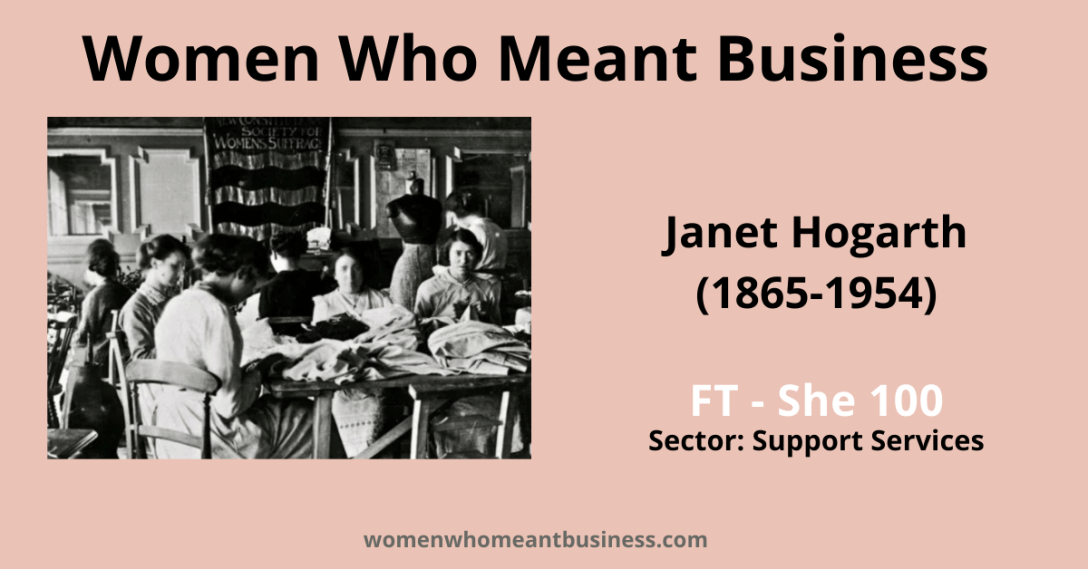
Born: Janet Elizabeth Hogarth; also known as Mrs W.L. Courtney; Mrs Janet E. Courtney
The August 1922 issue of Good Housekeeping featured a stirring article on ‘The Right to Work’ by Mrs W.L.Courtney. She ‘urged women to combat the repressive influence that is directed against their just claim to choose their own careers and pursue them unhampered by unfair restrictions.’ She praised the suffragettes for ‘suffering for the sake of an ideal’ and condemned the restrictions being placed on women’s careers in the wake of the First World War. This is the same woman who, in 1897, sought to dissuade women from making a career in journalism and in 1908 was a member of the Executive Committee for the Women’s Anti-Suffrage League. Despite her ground-breaking achievements and her contributions to the debate about women’s work in the late 19th century, Janet Hogarth’s path to becoming a fully paid-up feminist was long and winding.
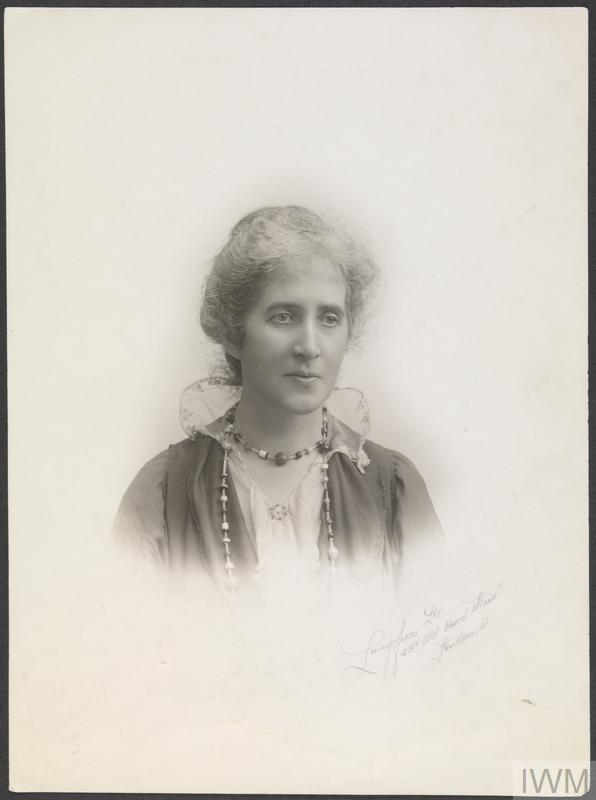
Copyright: © IWM. Original Source: http://www.iwm.org.uk/collections/item/object/205380144
Janet Hogarth was born in Lincolnshire on 27th November 1865, the daughter of a vicar. Her mother had fourteen children: child-bearing was, she felt, the ‘due price to pay for married happiness’. Six of them did not live to see their 50th birthdays. In 1869, Christopher Wordsworth was made the Bishop of Lincoln and ten years later his daughter, Elizabeth, became the founding principal of Lady Margaret Hall in Oxford. She secured a scholarship for Janet and in 1885 she arrived to study Philosophy, ‘a wonderful experience to a girl from a remote country parsonage.’ Her years in Oxford shaped her life: she made a life-long friend in Gertrude Bell; a fellow student, Hugh Chisholm, would provide her with employment; and she met her future husband, William Courtney, a fellow of New College and one of her philosophy tutors. Despite the many restrictions, she valued the fact that, because there were relatively few women at Oxford she had ‘every-day contact with masculine minds’ and she was later an advocate for co-education.
Janet gained the equivalent of a First Class degree though, like all women who studied at Oxford until 1921, she was unable to claim it. Dora Beale, the headmistress of Cheltenham Ladies’ College, offered her a part-time teaching job and in parallel she started writing for magazines such as Woman’s World. She soon decided to move to London and look for a different career, taking another part-time teaching job there to tide her over. Together with one of her sisters, a painter, Janet rented two rooms in Sloane Gardens House, nicknamed “The Pusseries”, and in the 1891 census described herself as a literary reviewer and author. Was it a coincidence that in 1890 William Courtney left his post at Oxford and also moved to London to take a role as a journalist at the Daily Telegraph?
The move to London
The turning point in Janet’s career came when she found a clerical post at the Royal Commission on Labour, starting work on 4th January 1892. In writing this blog I find so many rabbit holes I could dive down and one is the impact that this Commission had on the visibility and credibility of women, particularly in the Civil Service. Four Lady Assistant Commissioners, all of an incredibly high calibre, travelled around the country and wrote reports on pay and working conditions for women that received widespread coverage. They were:
- Eliza Orme (1848-1937): the first woman in England to earn a law degree.
- Clara Collet (1860-1948): economist and social reformer who collaborated with Charles Booth
- May Abraham (1869-1946), later May Tennant, who became Treasurer of the Women’s Trade Union League, the organisation founded by Emma Paterson.
- Margaret Irwin (1858-1940): full-time Scottish organiser of the Women’s Trade Union League.
Geoffrey Drage, an Oxford alumnus and Secretary to the Commission, (yet another man who has probably had no credit for his role in women’s advancement) also recruited sixteen, university-educated women to work as clerks. I have only been able to find the name of a couple apart from Janet, (Adelaide Anderson and Mary Elsee), but according to Janet, just like the four Assistant Commissioners, most went on to great things in either the Civil Service or education. For Janet, who had been entrusted with the general supervision of women clerks, it led in November 1893 to her appointment as the first superintendent of women clerks at the Bank of England.
The New Ladies of Threadneedle Street
The decision to bring women into the hallowed halls of the Bank of England was made in 1893. There was a team of (male) clerks sorting and listing cancelled bank notes and the Bank wanted to move them into more complicated jobs. When considering the options for fulfilling this menial but important work, there was a proposal that perhaps women could do it: they were cheaper than men to employ and would not need a career path. The directors decided to engage two women of ‘superior class’ who would be able to ‘thoroughly grasp the nature and objects of the system’ and add assistants as needed.
They wanted a Superintendent with proven experience in a public department or body and approaches were made to the Postmaster General and the Labour Commission. The task of finding her was given to the wife of Henry Grenfell, who had been Governor of the Bank of England in the 1880s. After she made a visit to the Labour Commission to explain the brief, Drage wrote to her in October 1893 suggesting Janet as Superintendent. In her supervisory role ‘she has shown great tact, prudence and common sense..she is able to take and give instructions intelligently. In her relations with the other clerks she has been straight-forward and business-like.’ She was also more than capable of dealing with complicated statistics, with a sound knowledge of French and German, a fair knowledge of Italian and some Spanish.’ In short, she was more than qualified.
The temptation to make a joke about the ‘new ladies’ of Threadneedle Street is one that few have been able to resist over time (including me) but Janet Hogarth quickly tired of it. ‘My first impressions of the bank were patriarchal – I felt as I had come amongst a company of kindly grandfathers.’ However, a kindly grandfather might have been keener to ensure his grand-daughter was being properly paid. In his letter of October, Drage had explained that, although Janet was currently on an annual salary of £150, she had not had a pay rise for two years. If she were to stay at the Labour Commission, it would be raised to £200 and would rise to £250 if the work was to continue for longer. As a result of her move, it took Janet more than ten years to earn a salary that might have been hers within two. Did she ever know what might have been? I suspect not.
Mary Elsee, aged 22 and a graduate of Girton College, Cambridge, where she had studied History, was Drage’s other recommendation. She had been working on the index for the report ‘and her work as far as I have seen it has been excellent. She is very careful and neat especially in the manipulation of figures and carries out instructions well. She was also on a salary of £150 ‘which I consider she fully deserves’ but he had already persuaded her ‘under the circumstances’ to take a 30% pay cut ‘with a prospect of rising.’
Life at the Bank
The Bank made the decision to hire Janet and Superintendent with Mary as her deputy in November 1893, for a trial period of a year and they started work in February 1894. A temporary wooden screen was set up in the Sub-Cashiers’ room to keep them out of male view and they were given access to a small kitchen.
Their first job was to start recruit a small group of women to do the actual work. Within two weeks, Janet had drafted a lengthy proposal covering the selection criteria, recruitment process and terms of employment and rules. With only five women needed at this point, Janet rated personal knowledge above statements of qualifications. She had three people in mind and suggested that the other two might be daughters of Bank of England employees or women with a personal recommendation from a Director.
Applicants should be between 18 and 28, preferably under 25, unmarried or widows, pass a health exam, provide a reference and give security of £200. They would be tested on handwriting, orthography, English Composition and simple arithmetic unless they had matriculated from the University of London or the Oxford or Cambridge Senior or Junior Local Examinations, in which case only the handwriting test was needed.
The working day would be 9.30am to 4pm, with a half-day on Saturday and a free lunch. The suggested annual pay was £50 (equivalent to an entry-level secretary), they would receive 27 days of holiday a year and had to resign if they got married. The first five women to be appointed were Emma Fyson, Jeannie Henderson, Florence Costelow, Helen Cherry and Edith C. Hogarth. Janet clearly had no problem with nepotism.
The new cadre of women clerks were expected to familiarise themselves and comply with a lengthy set of rules. ‘The excuse of ignorance will not be accepted.’ They included notice periods, lunch breaks and rules on dress.
‘Navy Blue, Black or very Dark Grey are the only colours which may be worn in the Offices. If collars are worn they must be white. During the summer white blouses are allowed but they must be absolutely white without coloured pattern or design up on them.’
By 1898, the number of clerks performing work that Janet herself described as monotonous had grown to around 40. When they reached the Bank, they were kept separate from the men, with their own entrance but travelling up in the morning and back in the evening, they were mixing with men. Janet used the London Underground and her public transport woes will resonate with commuters today: in a letter to The Times in 1900, she described her experience of trying to board the Central Line at Marble Arch on a rainy day. ‘About a hundred people stood waiting on the platform..three trains in succession came up crammed from end to end. Some ten fortunate people got in, the other ninety looked helplessly on. I turned to an official and asked if there were any chance of getting into the City. “Well no,” he said, “you see it’s wet!”‘ She gave up and took a bus.
A rising profile, a widening network
Given the lack of stretch in her job at the Bank (and possibly as a result of the stingy pay), it is not surprising that throughout her time there, Janet never stopped writing. In 1894, William Courtney was made editor of the Fortnightly Review and she was soon a contributor. She was one of the women invited to the Jubilee Dinner in 1897, part of the group representing achievements in Literature, and took Courtney as her guest. That same year she contributed to the Exhibition of Women’s Work organised by Daisy, Countess of Warwick and attended a garden party at Warwick Castle with Amy Bell, Helen Cox, Nancy Bailey, Cecil Gradwell and Louise Jopling. She probably had a chat there with her old boss, Dora Beale, headmistress of Cheltenham Ladies’ College and would have caught up with her sponsor, Elizabeth Wordsworth, who was Chair of the section on Education.
In January 1898 the Central Bureau for the Employment of Women, championed by Margaret Bateson, opened its doors and in November that year Margaret decided to use her column on Women’s Employment in The Queen to explore the question of Ladies in Business. Can Ladies succeed in business? And if so what are the conditions of success? Daisy, Countess of Warwick, Agnes Garrett, Mrs Selby-Bigge, owner of the Ladies’ Shirt Company in Sloane Square and Janet shared their perspectives. ‘I think that ladies when they first go into business often find a certain difficulty in recognising their obligation to perform duties regularly which they have undertaken. Drudgery oppresses them and they try to escape it. But on the whole I believe that ladies are developing business capacity and acquiring business habits.’ At the Women’s International Congress the following year, she presented a paper on the qualifications of women for Clerical Work.
Books and suffrage
In 1905, she quit her job at the Bank of England and found a position in January 1906 at The Times Book Club as the Chief Librarian. It was a new venture, the brainchild of the newspaper’s managing editor, Charles Moberly Bell, and its advertising manager, Horace Everett Hooper. Its aim was to increase newspaper circulation, and thereby advertising revenue, by offering readers the free loans of books. Although there were plenty of lending libraries across the UK, a payment usually had to be made to borrow a book. (Florence Boot had set up the Book-Lovers Libraries in branches of Boots in 1898 with a similar objective of attracting new customers and building loyalty.). Its headquarters were at 376-384 Oxford Street. Publishers were up in arms about about the scheme, seeing it as a threat to their sales and their advertising boycotts of the Times contributed to the scheme being relatively short-lived. Hooper was sacked and went to work on the preparation and publication of the 11th edition of the Encyclopedia Britannica. Janet followed him there.
It was around now that came what seems, to me at least, the most surprising event in Janet Hogarth’s life: she joined the Women’s National Anti-Suffrage League (WASL). I have written a separate post about the women’s anti-suffrage movement, its rationale and its role. Janet plays down her participation in her 1926 autobiography, admitting that she had ‘sided’ with Mary Ward but in fact she and Gertrude Bell were both prominent in the movement and on the WASL’s Council. It seems to have been her marriage to William Courtney in 1911 that forced a re-evaluation, when she experienced for herself what the Women’s Tax Resistance League had been campaigning about for some time: the indignity of suddenly being deemed incapable of paying her own taxes. ‘The realisation of this, though I had long known it in theory, did finally topple me off the fence into the suffragist camp.’ Or, perhaps more accurately, caused her to jump over the fence.
While she was flip-flopping on the subject of women’s suffrage, Janet was consistent in her support for women’s economic and employment rights and recognised their contributions when she could. Ahead of the publication of the 29-volume 11th edition of the Encyclopedia Britannica in 1911 she co-hosted a dinner for more than 200 people at the Savoy Hotel celebrating the contributions made by women. In an ‘amusing and practical speech’ she rejoiced in the fact that women had demonstrated their rightful place in the learned world and that, for the first time, their contribution to producing a ‘great work of learning’ was being publicly recognised. She also took the opportunity to reel off statistics showing the progress of women in the workplace including the Post Office, the Bank of England and journalism. In 1914 she was again involved in the International Women’s Congress, this time sending a paper to the event in Rome in 1914 on ‘Women in Professions’ as her contribution to the debate on equal pay for equal work.
Later years
During the war Janet worked at the Ministry of Munitions as a superintendent of women’s welfare and was awarded an O.B.E in the same honours list that recognised Ethel Wood and Laura Annie Willson. They all attended the same investiture ceremony in October: if only there were more photographs of this historic event!
In the interwar years, she was one of the first woman to be made a Justice of the Peace and was a Trustee of the Pension Fund for Educated Women. She was also among the first women to contribute to Good Housekeeping, writing in August 1922 on ‘The Right to Work’. In the wake of the Restoration of Pre-War Practices Act, the prevalence of Marriage Bars, and the pressure women in the upper- and middle-classes were being put under to withdraw from the world of work altogether, she wrote:
‘Nothing is more noticeable in the present pause – not to say set-back – of the woman’s movement than the virtual denial of that primary and inalienable right of the human personality to realise itself in the exercise of its proper functions… Women must turn a deaf ear to all pleading, however plausible, which urges them to stunt their development and dwarf their activities by denying themselves a professional career, simply because they have been fortunate enough to inherit a small competence or marry a man able to support them… Our reward will be the increased respect given, consciously or unconsciously, to the independent.’
Janet devoted her 60s and 70s to writing, publishing a number of books including a biography of her husband, her own memoirs and profiles of distinguished women, both those she had known herself and those who had contributed to the women’s movement in the 1830s. She was widowed in 1928 but continued to live ‘an unusually full and varied life’ until her death in 1954. I think it is this variety that has contributed to the full extent of her career and contribution to the feminist agenda being undervalued. The fact that she changed her name when she was in her 40s has surely also not helped: it took me a while to realise that the Mrs W.L Courtney who wrote for Good Housekeeping in 1922 was Janet Hogarth but the content of that article and the fact that she was asked, almost certainly by Alice Head, to write it, give valuable insight into her views and network in her later years and, I hope, mean that her story is now a little fuller.
Sources include:
Material from the archives of the Bank of England and its publication ‘Women in the Bank: Their History 1894-2017’.
‘A Monstrous Regiment of Women’ by Janet Hogarth in Nineteenth Century, December 1897; ‘The Right to Work’ by Mrs. W.L. Courtney in Good Housekeeping, August 1922; ‘Recollected in Tranquility’ by Janet E. Courtney (1926);
Bucks Advertiser & Aylesbury News 3/8/1889; St. James’s Gazette 8/12/1897; The Queen 11/12/1897; Gentlewoman 25/12/1897; The Queen 26/11/1898; The Times 4/10/1900; The Times 14/10/1910; The Queen 30/5/1914; The Sphere 6/10/1917; The Times 25/9/1954
An Evaluation of Anti-Feminist Attitudes in Selected Professional Victorian Women by May Witwit (2012) Dissertation (unpublished)
 Women Who Meant Business