Sector: Construction
Born: Emily Stevens
She changed the shape of Newark with her building and industrial projects
“How do you find the women you write about?” I am sometimes asked. The answer is that their names come from all sorts of places – it could be that they are already well-known, like Octavia Hill and Gertrude Jekyll; they might crop up in a book or an exhibition like Betty Joel and Lucy Duff Gordon; or I come across them while I am researching someone else, they are in the network of someone else like Irene Manby and Ethel Wilson. Emily Blagg has found her way in because she was featured in an episode of Bargain Hunt that my mother (a successful Bargain Hunt contestant!) happened to see.
Filmed in the town of Newark, in Nottinghamshire, the programme took a break from following the Red and Blue teams to look at the story of this local property developer. ‘Perhaps she could be one of your women? said my mother. As she often is, she was right.
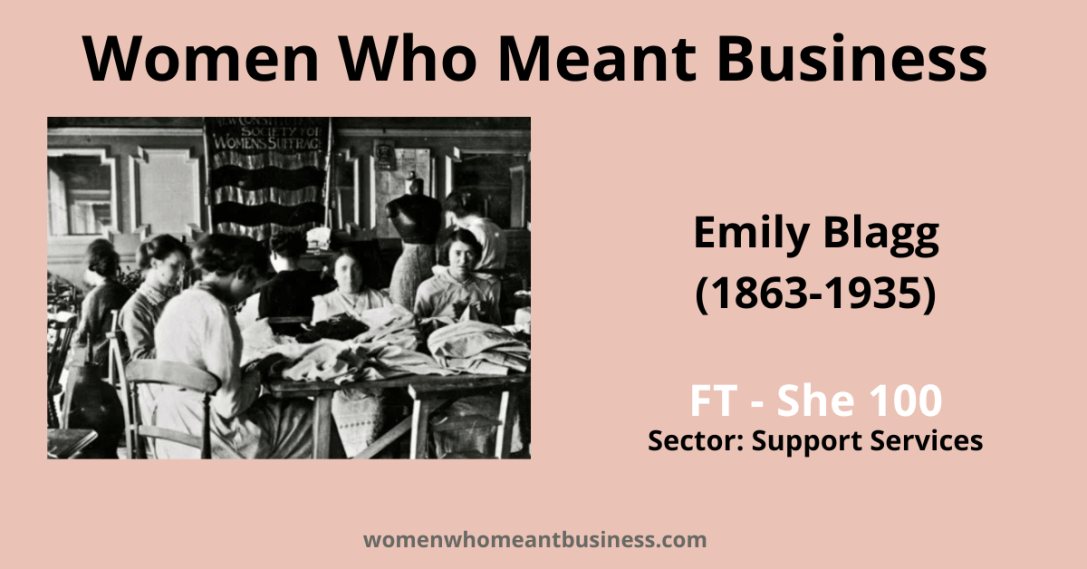
Emily Stevens was born in Stoke, Worcestershire in 1863. She trained as a dressmaker and in 1883 moved from Altrincham to Newark where she joined Cooper and Co. In 1876 this local clothing firm had started to pivot away from retail clothes sales to wholesale clothing manufacturing. It was a transformational move. Emily joined a fast-growing company and became an important part of the management team. In 1895 she organised a ball at the Town Hall for the ‘flourishing firm’, and was ‘indefatigable in providing for all the guests’. It became an annual event, hosted by the management and heads of departments, of which Emily was one. In 1897, employees had dinner at midnight and danced waltzes, polkas, gavottes and barn dances until 4.30am.
A material change
By 1901, Cooper and Co was employing over 400 people: ‘much of the success is due to the energetic heads of the workrooms, all up-to-date go-ahead businesswomen’, reported the local newspaper, with Emily’s name first on the list. She was also responsible for buying, making trips to Paris to buy silk and other fabrics. Then in the early 1900s, she swapped cotton for clay, making an unexpected move into housing development. She secured land to build The Park, a street of semi-detached houses set along a tree-lined avenue off London Road, one of Newark’s principal streets. She became a major shareholder in a brick works in Dinnington near Sheffield where she built houses for workers in the local coal mines.
There is little known about Emily’s private life. On 22nd January 1906 she married William Blagg, a local cattle dealer ten years her junior. For some reason, their wedding was held at St. Paul’s Church in Hulme, Manchester, perhaps because members of Emily’s family were living in that area. Their marriage seems to have been short-lived: by 1911 they were living separately in Newark. Emily was living at no. 2 The Park while William was living with his mother in the centre of town.
In 1912 Emily launched her next property venture, partnering with a local builder, John Vickers. Initially it was known as The Shrubberies, but it was quickly re-named Lime Grove. She saw an opportunity in Newark’s increasing importance as a location for new industries and the development had small terraced houses for workers and larger villa residences for managers. Emily eventually moved into one of the largest houses, where she would live until her death. The building work was not without its challenges: twelve boys ended up in court for doing ‘wilful damage’ to materials including sewer pipes and chimney pots. The alderman hearing the case bemoaned the fact that Newark boys were ‘like heathens’ – he didn’t know where they got their manners from. They were let off with the threat of a birching if they were seen in court again.
Emily’s next move was into another fast-growing area, the world of motion pictures. She bought the site of the Ford carriage works on the corner of Barnbygate and Baldertongate where she built the town’s first purpose-built cinema. The 1,000 seater Kinema opened in 1913 and continued to operate, under various names, until 1958. Just before the war, she also attempted to secure another site in the centre of town, occupied by the 17th century Chauntry House, but was unsuccessful. During the war it was commissioned for use as a hospital and then in 1919 Emily made another bid to buy it, this time with success. She demolished it, despite local objections and built a second cinema, the Palace. She was both financier and clerk of works for the Palace project and could be seen at the age of 57 climbing up ladders and inspecting the roof.
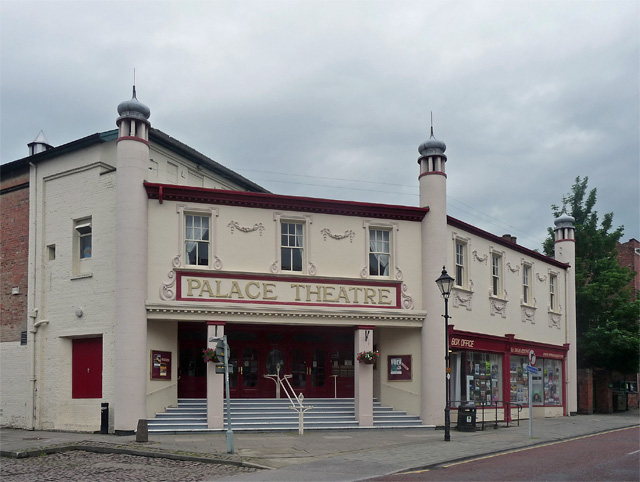
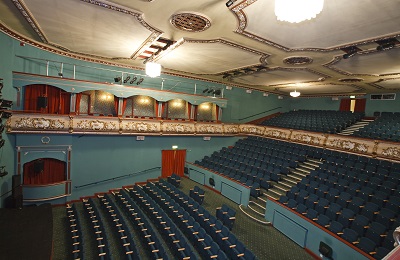
Exterior and interior of the Palace Theatre
However, soon after its completion, she sold her interest in both of them and moved into a new area, manufacturing.
Enjoying this story? Subscribe to my newsletter or follow me on instagram to find out more about pioneering business women and their networks, as well as relevant exhibitions, talks, books and events.
Putting her pedal to the metal
In 1921, Emily became the principal shareholder in a new business, Blagg and Johnson Ltd, a sheet metal works that started off making pipes, guttering and other ‘rainware’. Her partner, Frank Millhill Johnson, was Australian-born and brought his experience of working in the pressed steel industry in the United States, from where the manufacturing equipment was sourced. How he ended up as a partner in a Newark business is not clear and he was not involved for very long. However, his contribution to the business’s success was significant: one of its most successful products was the Jupiter Metal Angle Bead, an exterior reinforcing bead that helped create sharp corners on rendered buildings, which Frank had patented. By the late 1920s Blagg and Johnson had expanded into other areas such as sheet metal door and window frames. The factory was next to the railway sidings, making it easy to collect the sheet metal that had been ordered and distribute the finished products.
Emily registered another new business in 1925, the Newark Brick Company. The other Directors were her brother, Walter, John Vickers, and Annie Maria Adlington. a widow and a neighbour of Emily’s. The clay was sourced from the land under the steel works and the company was wound up in 1929, possibly because the supply had been exhausted.
Emily was involved in her businesses as long as her health held up. She died at her home in April 1935 after a long illness, a wealthy woman. Emily doesn’t seem to have been a great ‘joiner’ – she is surely the Mrs Blagg who is commended for her support in gathering signatories for a suffrage petition in Newark in February 1910 but otherwise there is no reference to her in any of the women’s newspapers before or after the war, or in the Woman Engineer, the journal of the Women’s Engineering Society. Nevertheless, there was a big turnout for her funeral with over thirty floral tributes, remembering this entrepreneurial woman with an eccentric manner.
Emily Blagg’s story is also a story about the role of local newspapers in recording our national history. Like Maud Carpenter, what we know about Emily is due almost entirely to local newspaper stories, in particular those of the Newark Advertiser, where she first made an appearance in 1895 and is still being written about in the 2020s. In revenue terms, the regional news sector in 2022 was about a quarter of the size it was in 2007 and more than 320 local titles closed between 2009 and 2019. Facebook might be the new channel of choice for community news, but I doubt we will be able to search for and find stories about any of the people featured on those pages in 2125.
Sources include:
Newark Advertiser 9/1/1895; 13/1/1897; 10/7/1901; The Common Cause 3/2/1910; Newark Herald 18/5/1912; Kinematograph Weekly 1/5/1919 Newark Herald 13/4/1935;
Newark Advertiser 2/10/1998; 3/9/1999
 Women Who Meant Business